
Blog • Published on:March 10, 2026 | Updated on:March 10, 2026 • 13 Min
Top 5 Richest Cities in Africa in 2026
Wealth across Africa is increasingly concentrated in a small number of rapidly growing metropolitan areas.
These cities serve as financial centers, technology hubs, and key gateways for regional and international investment.
From Johannesburg and Cape Town in the south to Cairo, Lagos, and Nairobi, these urban economies attract entrepreneurs, multinational companies, and high-net-worth individuals seeking business opportunities and long-term growth.
This guide examines the richest cities in Africa, highlighting where the continent’s millionaires live, which industries drive urban wealth, and how investors are engaging with Africa’s fastest-growing economic centers.
What Are the Richest Cities in Africa?
The richest cities in Africa currently include:
- Johannesburg, South Africa
- Cape Town, South Africa
- Cairo, Egypt
- Nairobi, Kenya
- Lagos, Nigeria
These cities host the continent’s largest concentrations of private wealth, multinational companies, and high-net-worth individuals. Their economies are supported by sectors such as finance, energy, real estate, technology, tourism, and international trade.
Top 5 Wealthiest Cities in Africa
Where Wealth Is Concentrated in Africa
Across Africa, wealth is heavily concentrated in major metropolitan centers rather than rural regions.
These cities act as economic engines for their countries, attracting corporations, investors, and entrepreneurs.
Urban hubs such as Johannesburg, Cairo, Lagos, Cape Town, and Nairobi host the majority of the continent’s financial institutions, multinational headquarters, and high-value real estate markets. As a result, they also concentrate a large share of Africa’s high-net-worth individuals.
Rapid urbanization has played a major role in this shift. As infrastructure improves and industries expand, cities continue to attract both domestic migration and foreign investment.
Several economic developments over the past decade have accelerated this concentration of wealth.
Key Drivers Behind Urban Wealth Growth
A number of structural trends have supported the rise of Africa’s leading wealth cities.
Foreign Direct Investment (FDI)
Governments across the continent have introduced incentives to attract international investors, particularly in sectors such as energy, technology, infrastructure, and manufacturing.
Infrastructure Development
Large-scale investments in transport networks, ports, housing, and digital infrastructure have strengthened the economic capacity of cities like Lagos, Nairobi, and Cairo.
Public-Private Partnerships (PPPs)
Collaborations between governments and private companies are helping finance major development projects, including smart cities, industrial zones, and logistics hubs.
Digital Transformation
The rapid expansion of fintech, mobile banking, and e-commerce has created new wealth opportunities, particularly in technology hubs such as Nairobi and Lagos.
Together, these factors have accelerated economic growth and helped several African cities emerge as major centers of private wealth and investment activity.
Top 5 Wealthiest Cities in Africa
Johannesburg
Johannesburg (fondly called “Joburg” by locals) continues to rank as Africa’s wealthiest city, maintaining its reputation as the continent’s primary financial center.
The city remains home to the largest concentration of millionaires in Africa, with roughly 11,700–12,300 high-net-worth individuals, according to the latest Africa Wealth Report estimates.
Historically known for its gold mining industry, Johannesburg’s modern economy has expanded far beyond minerals. Today, the city hosts major financial institutions, multinational corporations, and the Johannesburg Stock Exchange (JSE), the largest stock exchange in Africa.
Leading Industries: Finance, mining, manufacturing, technology, retail
Lifestyle and Luxury: Much of the city’s private wealth is concentrated around Sandton, widely considered the richest square mile in Africa and a hub for banking, luxury real estate, and high-end retail.
Key facts about Johannesburg
- Financial and Stock Exchange Hub: Headquarters of the JSE, Africa’s largest stock exchange.
- Global Connectivity:O.R. Tambo International Airport is one of Africa’s busiest aviation hubs.
- Infrastructure and Tech: Modern road networks, major universities, and incentives supporting technology startups and foreign investment.
Cape Town
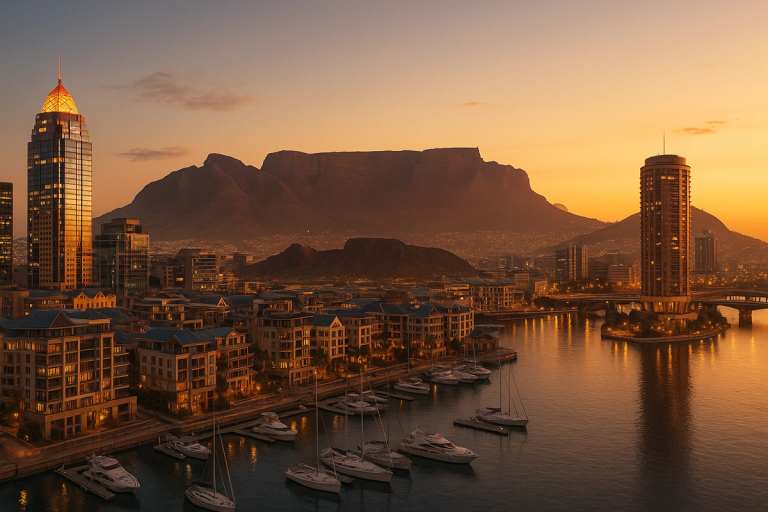
While Johannesburg remains South Africa’s financial center, Cape Town has emerged as one of Africa’s fastest-growing wealth hubs.
The city currently hosts approximately 7,400 to 8,500 millionaires, placing it second among Africa’s wealthiest cities.
Cape Town combines strong tourism, real estate investment, and a growing technology sector. Its startup ecosystem, often called the “Silicon Cape,” has attracted venture capital and helped expand the local fintech and e-commerce industries.
Leading Industries: Tourism, financial services, technology, creative industries (film, media, design)
Lifestyle & Luxury: The Atlantic Seaboard, including Clifton and Camps Bay, hosts some of Africa’s most expensive residential properties and remains a preferred location for wealthy residents and international investors.
Key facts about Cape Town
- Tourism Magnet: Table Mountain, the Cape Winelands, and world-class hospitality attract global visitors.
- Technology Hub: The Silicon Cape initiative has supported the growth of fintech and software startups.
- High Quality of Life: Known for its beaches, outdoor lifestyle, cultural scene, and international schools.
Cairo
Located along the Nile River, Cairo is the economic and political center of Egypt and the wealthiest city in North Africa.
The city hosts around 7,200 millionaires and several billionaires, supported by strong sectors such as manufacturing, finance, telecommunications, and real estate development.
Major infrastructure initiatives, including the New Administrative Capital project and expansions linked to the Suez Canal Economic Zone, have attracted both domestic and international investment.
Leading Industries: Oil and gas, manufacturing, tourism, telecommunications, real estate
Lifestyle & Luxury: Wealthy residents often concentrate in districts such as Zamalek, Heliopolis, Maadi, and New Cairo, where upscale developments, international schools, and luxury apartments have expanded.
Key facts about Cairo
- Strategic Location: Positioned between Europe, the Middle East, and Africa, making it a major trade gateway.
- Tourism and Heritage: Egypt’s tourism sector continues to drive investment in hospitality and real estate.
- Infrastructure Expansion: Large national projects continue to attract investors and developers.
Lagos
Lagos is widely recognized as the commercial capital of West Africa and the primary economic engine of Nigeria.
The city hosts approximately 4,200 millionaires, reflecting strong growth driven by the country’s energy sector, telecommunications industry, and expanding startup ecosystem.
Despite infrastructure challenges, Lagos continues to attract entrepreneurs and multinational companies looking to access Africa’s largest consumer market.
Leading Industries: Oil and gas, financial services, telecommunications, entertainment, e-commerce
Lifestyle & Luxury: Neighborhoods such as Ikoyi, Victoria Island, Banana Island, and Lekki host luxury residential developments, shopping districts, and corporate headquarters.
Key facts about Lagos
- Large Consumer Market: Nigeria’s population and economic scale create strong demand for goods and services.
- Startup Ecosystem: Lagos has become a major African hub for fintech and digital startups.
- Strategic Port City: A key gateway for trade across West Africa.
Nairobi
Nairobi, the capital of Kenya, has developed into East Africa’s leading technology and innovation hub, often referred to as “Silicon Savannah.”
The city hosts roughly 4,200–4,400 millionaires, reflecting strong growth in financial services, technology startups, and international investment.
Nairobi has become a center for fintech innovation, supported by the global success of mobile money platforms such as M-Pesa.
Leading Industries: Financial services, technology, agriculture, tourism, manufacturing
Lifestyle & Luxury: Wealthy residents often live in suburbs such as Karen, Muthaiga, Runda, and Gigiri, known for gated communities, international schools, and large private homes.
Key facts about Nairobi
- Regional Business Hub: Headquarters for many multinational companies operating across East Africa.
- Innovation Ecosystem: Strong venture capital interest in fintech, agritech, and logistics startups.
- Economic Growth: Kenya’s pro-business environment continues to attract investors.
Africa's Economic Landscape in 2026
Looking at Africa in 2026, several structural factors continue to shape the continent’s economic environment and support the growth of its leading wealth cities.
1. Young, Technology-Driven Population
Africa remains the world’s youngest continent. A rapidly expanding workforce is entering sectors such as technology, fintech, and digital services.
Cities like Lagos and Nairobi have become startup hubs attracting venture capital and international investors.
2. Natural Resources and Economic Diversification
Natural resource exports such as oil, gas, and minerals still play a major role in many African economies.
However, major cities are increasingly diversifying into financial services, technology, manufacturing, and logistics, helping reduce dependence on commodities.
3. Regional Trade Integration
Regional trade initiatives such as the African Continental Free Trade Area (AfCFTA) continue to strengthen cross-border commerce across the continent.
As trade barriers gradually decrease, cities with strong infrastructure and financial systems are expected to benefit from expanding business activity.
Together, these developments are contributing to growing urban wealth, expanding entrepreneurial ecosystems, and increasing investment activity across Africa’s major metropolitan economies.
Where African Millionaires Live and Invest
HNIWs across Africa tend to concentrate in major metropolitan centers where business activity, financial services, and luxury real estate markets are strongest.
Cities such as Johannesburg, Cape Town, Cairo, Lagos, and Nairobi host a large share of the continent’s wealthy residents.
These cities offer developed financial infrastructure, international connectivity, and high-end residential communities.
Wealthy individuals in these urban centers typically invest in real estate, financial markets, technology startups, and diversified global portfolios, often holding assets both within Africa and internationally.
Distribution of HNWIs
HNWIs across Africa are largely concentrated in cities that support key industries such as finance, telecommunications, energy, technology, and real estate.
South African cities like Johannesburg and Cape Town continue to lead in terms of total wealth, while emerging innovation hubs such as Lagos and Nairobi have experienced rapid growth in their millionaire populations over the past decade.
Premium Residential Areas and Investment Zones
Across Africa’s wealthiest cities, affluent residents tend to live in well-established luxury neighborhoods offering security, modern infrastructure, and proximity to business districts.
- Johannesburg: Bryanston, Sandown, Westcliff
- Cape Town: Clifton, Camps Bay, Constantia, Bishopscourt
- Cairo: Zamalek, Heliopolis, Maadi, New Cairo
- Lagos: Ikoyi, Victoria Island, Banana Island, Lekki
- Nairobi: Karen, Muthaiga, Runda, Gigiri
These areas feature luxury homes, international schools, business centers, and premium lifestyle amenities that attract both local and international investors.
Premium Residential Areas by City
Many wealthy investors also diversify their portfolios by investing in commercial developments, hospitality projects, and real estate markets in other emerging African cities, including Accra, Kigali, and Dar es Salaam.
Future Outlook: Africa’s Next Wealth Capitals
While Johannesburg, Cape Town, Cairo, Lagos, and Nairobi currently dominate Africa’s wealth landscape, several other cities are emerging as important economic centers.
Growing foreign investment, infrastructure development, and expanding technology sectors are positioning these cities as potential future wealth capitals.
Accra, Ghana
Accra continues to attract international investors thanks to Ghana’s political stability, economic reforms, and growing financial sector. The city is becoming a regional hub for business services, trade, and real estate investment.
Luanda, Angola
Luanda remains one of Africa’s major energy capitals. Supported by Angola’s oil sector and infrastructure development projects, the city continues to expand its commercial and financial activity.
Abidjan, Côte d’Ivoire
Abidjan has emerged as one of West Africa’s fastest-growing financial centers. Strong economic growth, expanding infrastructure, and increasing foreign investment are strengthening the city’s role as a regional business hub.
Economic Projections
Several trends are expected to shape the future development of Africa’s major urban economies.
Economic Growth
Many African economies are projected to maintain strong growth rates as industrialization, technology adoption, and entrepreneurship expand across the continent.
Digital Infrastructure Expansion
Increasing smartphone usage, mobile banking adoption, and digital connectivity are accelerating economic activity in both urban and surrounding regions.
Sustainable Development
Investments in renewable energy, climate-resilient agriculture, and sustainable infrastructure will play an important role in supporting long-term urban growth.
Development Initiatives
Large-scale development projects across Africa are expected to support the rise of new economic centers.
Smart City Projects
Initiatives such as Kigali Innovation City in Rwanda and Konza Technopolis in Kenya aim to create technology-driven urban environments designed to attract global businesses and research institutions.
Green Infrastructure
Renewable energy projects, including solar and wind developments across North and East Africa, are expanding rapidly as countries invest in sustainable energy solutions.
Industrial and Manufacturing Expansion
Countries such as Ethiopia and Senegal are investing heavily in industrial parks and manufacturing zones to strengthen exports and local production capacity.
How to Access Africa’s Wealthy Cities Through Investment
For investors and entrepreneurs looking to benefit from Africa’s growing urban economies, investment migration programs can offer a pathway to residency, business opportunities, and long-term market access.
Several countries across the continent provide options for investors seeking to establish residence or strengthen their presence in high-growth markets.
Savory & Partners assist clients in identifying suitable investment routes and navigating application procedures.
Residence by Investment Programs
Some African countries offer residency permits to individuals who make qualifying investments or demonstrate sufficient financial resources.
Mauritius Permanent Residence Permit
Mauritius offers residency options designed for investors, entrepreneurs, and high-net-worth individuals seeking a stable and tax-efficient jurisdiction.
South Africa Financially Independent Permit
This program allows wealthy individuals to obtain permanent residence without employment requirements, provided they meet financial criteria and demonstrate sufficient assets.
Government Bonds and Infrastructure Investments
Certain jurisdictions allow residency pathways through investment in government bonds or national development funds, supporting public infrastructure projects.
Citizenship by Investment Programs
Citizenship by investment options remain limited across Africa but are gradually emerging in several countries.
Egypt offers investors the opportunity to obtain citizenship through qualifying investments that contribute to the country’s economic development.
Business and Real Estate Investments
Investors seeking access to Africa’s major cities often focus on high-growth sectors such as real estate, technology, energy, and infrastructure.
Examples of prime investment locations include:
Victoria Island and Ikoyi (Lagos)
Major financial and residential districts attracting luxury property development and corporate investment.
Sandton (Johannesburg)
One of Africa’s most important financial centers, known for its concentration of banks, multinational corporations, and premium commercial real estate.
Westlands and Karen (Nairobi)
Rapidly growing areas with strong demand for both residential and commercial property.
Investments in these districts provide access to growing urban markets, expanding business ecosystems, and increasing property demand.
Investment Migration Solutions
Professional advisory firms typically guide investors through several key stages of the investment migration process:
1. Initial Consultation
Assessing eligibility and identifying suitable jurisdictions and investment options.
2. Documentation and Due Diligence
Preparing application documents and ensuring compliance with regulatory requirements.
3. Property or Business Investment
Selecting appropriate real estate projects or business opportunities aligned with investment goals.
4. Residency or Citizenship Application
Submitting and managing applications with relevant government authorities.
5. Post-Investment Support
Providing assistance with property management, business establishment, and relocation.
These services help investors navigate Africa’s expanding markets with greater confidence and regulatory clarity.
Wrapping Up: Africa’s Richest Cities Leading the Way
Africa’s leading wealth cities continue to play a central role in shaping the continent’s economic future. Cities such as Johannesburg, Cape Town, Cairo, Lagos, and Nairobi remain key financial and commercial centers, attracting entrepreneurs, multinational companies, and high-net-worth individuals.
These urban economies offer growing opportunities across sectors including real estate, technology, finance, infrastructure, and international trade. As investment continues to expand and infrastructure improves, Africa’s major cities are expected to strengthen their positions as regional hubs for business and wealth creation.
For investors looking to establish a presence in Africa’s emerging markets, these cities provide access to dynamic economies, expanding consumer markets, and long-term growth potential.
FAQs on The Richest Cities in Africa
1. Which African city has the highest number of billionaires?
Among Africa’s leading wealth cities, Cairo currently hosts the highest number of billionaires, supported by strong sectors such as real estate, manufacturing, and telecommunications.
2. What industries drive wealth in Johannesburg?
Johannesburg’s economy is driven primarily by financial services, mining, manufacturing, retail, and technology. The presence of the Johannesburg Stock Exchange (JSE) and numerous multinational corporations reinforces its position as Africa’s largest financial hub.
3. Why has Lagos experienced rapid millionaire growth?
Lagos has seen strong growth in its millionaire population due to expansion in technology startups, telecommunications, finance, and entertainment industries such as Nollywood and digital media.
4. What investment opportunities exist in Nairobi’s real estate market?
Nairobi offers investment opportunities in both residential and commercial property, particularly in areas such as Karen, Runda, and Westlands, where demand from multinational companies and international organizations continues to grow.
5. How can foreign investors access residency opportunities in Africa?
Foreign investors can explore residency pathways through investment migration programs, property investments, or business development initiatives, often with the guidance of advisory firms such as Savory & Partners, which assist with application processes and regulatory requirements.
Written By

Alice Emmanuel
Alice Emmanuel is an expert in residency and citizenship by investment, specializing in government compliance and program optimization. With over 8 years of experience, she has guided high-net-worth individuals through acquiring global mobility and new citizenships, particularly in Europe, the Caribbean, and the Middle East. Alice's in-depth knowledge of Middle Eastern residency programs makes her a trusted advisor for investors seeking security and diversification in the region.
Related Articles







Recently Published








Book a free consultation